Quality & Value
Quality & Value Overview
BIM Application
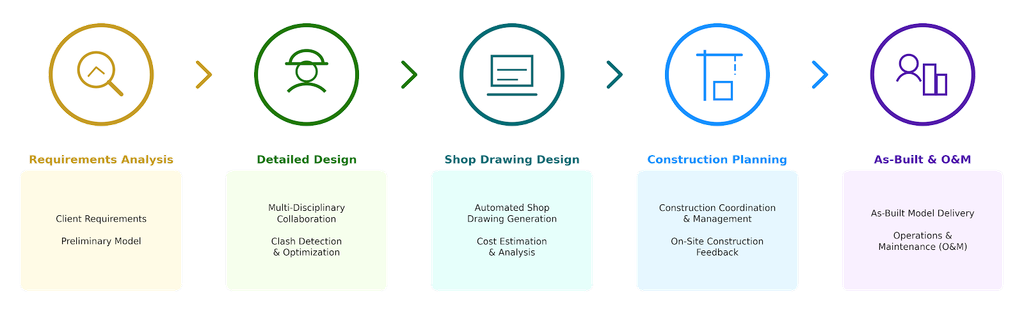
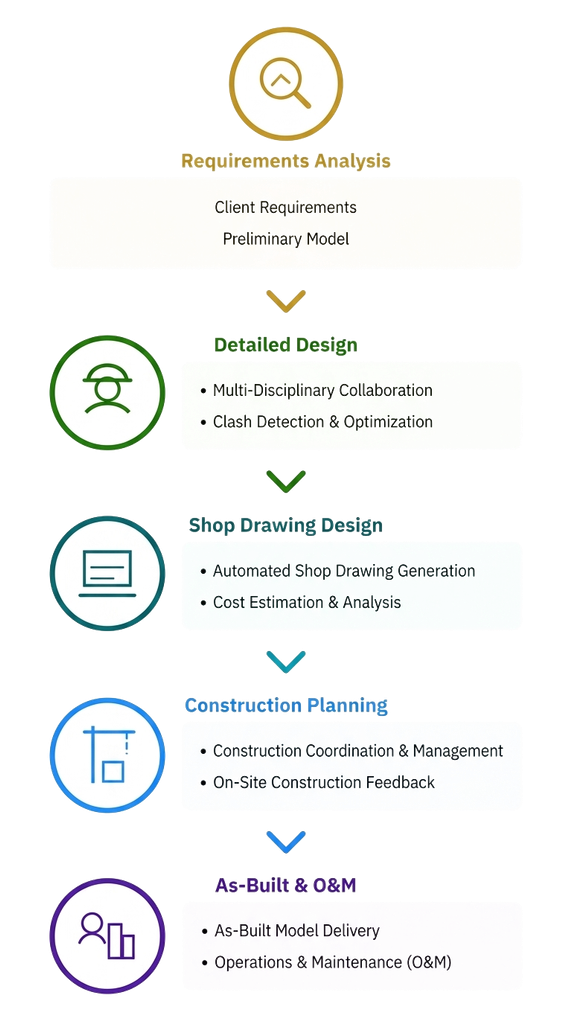
Tianmu Changyu Project: BIM Application Examples
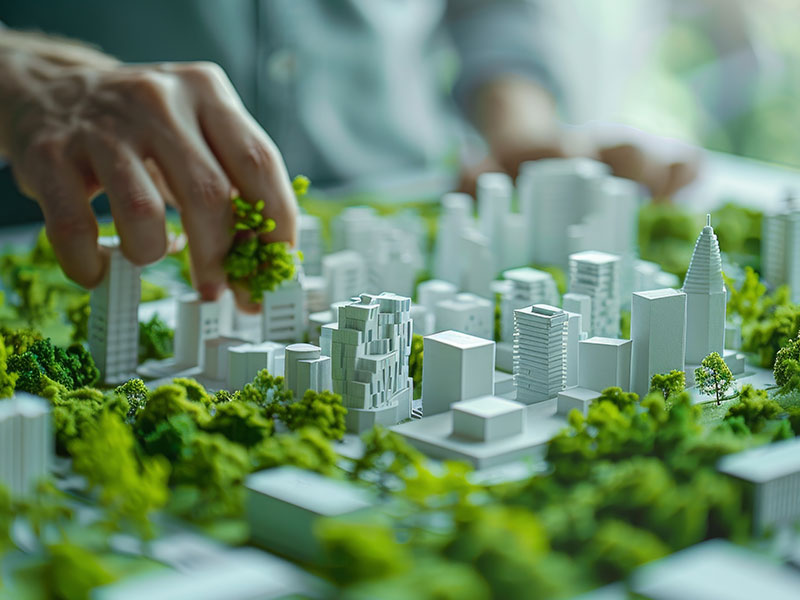
In the Tianmu Changyu development project, Dehwa Construction integrated Building Information Modeling (BIM) technology as a critical tool to enhance design accuracy and construction efficiency. Through BIM model reviews of the staircase spaces, the team identified issues in certain floors, such as insufficient headroom and structural deficiencies where short columns and beams were missing. This enabled the design team to make necessary adjustments prior to construction, preventing late-stage design modifications or rework close to deadlines. Consequently, this significantly mitigated downstream risks and costs while allowing ample time to pursue the most suitable solutions.
In residential development projects, the common transition layer connection issues on exterior walls were also effectively resolved using the spatial visualization feature of the BIM model, which compensated for the spatial blind spots that traditional 2D drawings struggle to represent. Through the model, the design and construction units were able to coordinate and discuss prior to the commencement of work, ensuring details were clarified in advance and further strengthening the construction interface connections between floors.
The curved design space of Building B was the greatest construction challenge in this project. This space houses two staircases; to conserve space, the staircase ring beams were built following the staircase elevation while simultaneously aligning with the curved exterior wall. This made elevation control and setting-out precision exceptionally difficult and complex.
Here, the BIM model played an irreplaceable role in communication. Traditional 2D drawings struggle to fully convey these complex spatial intersections, but through the BIM model, we were able to clearly demonstrate the relative positions and connections to the site workers. This significantly reduced comprehension difficulty and ensured precise, error-free construction.
Throughout the construction process, whether addressing drawing ambiguities or site issues, the team was able to provide real-time explanations and coordination through BIM, transforming what was originally abstract or hard-to-grasp 2D spatial information into an intuitive 3D space. BIM is not merely a technical tool; it acts as a bridge connecting understanding and trust between design and site, as well as between planning and execution.
This practical experience once again validated the true value of BIM in architectural projects. It is not merely a powerful tool for problem-solving, but a mechanism that empowers the team to tackle every challenge with greater poise, collaboration, and sustainability.
Waste Management
► We comply with regulatory standards for waste management, ensuring that every process—from collection and segregation to reuse or landfill disposal—adheres to environmental protection standards.
► According to current site data, the total generation of mixed construction waste in 2025 reached 2,610.68 metric tons. All waste was handled by certified management contractors and reported in accordance with official regulations.
► To minimize environmental impact, we actively promote waste reduction through enhanced resource recycling, prioritizing the use of recycled building materials, and optimizing construction processes—all dedicated to achieving the goal of resource circulation.
Waste Management Workflow
Dehwa Construction strictly adheres to statutory requirements for waste management, regulating the disposal process of mixed construction waste (R0503) in accordance with the provisions of the Waste Disposal Act. The entire workflow—spanning waste collection and segregation to final recycling or landfill disposal—is handled by certified management contractors, accompanied by mandatory reporting and monitoring to ensure full compliance with environmental standards. This process not only minimizes the environmental impact of waste but also promotes resource recirculation.
1. Waste Collection and Transportation
2. Processing and Reuse

3. Processing Records and Reporting
Waste Reduction Measures
To effectively reduce construction waste, Dehwa Construction plans to implement the following measures in the future:
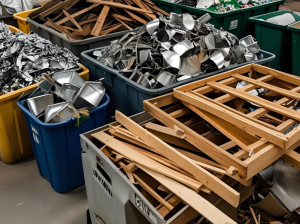
1. Enhancing Resource Recycling
2. Adoption of Recycled Materials